Pricing Tool for International Bank
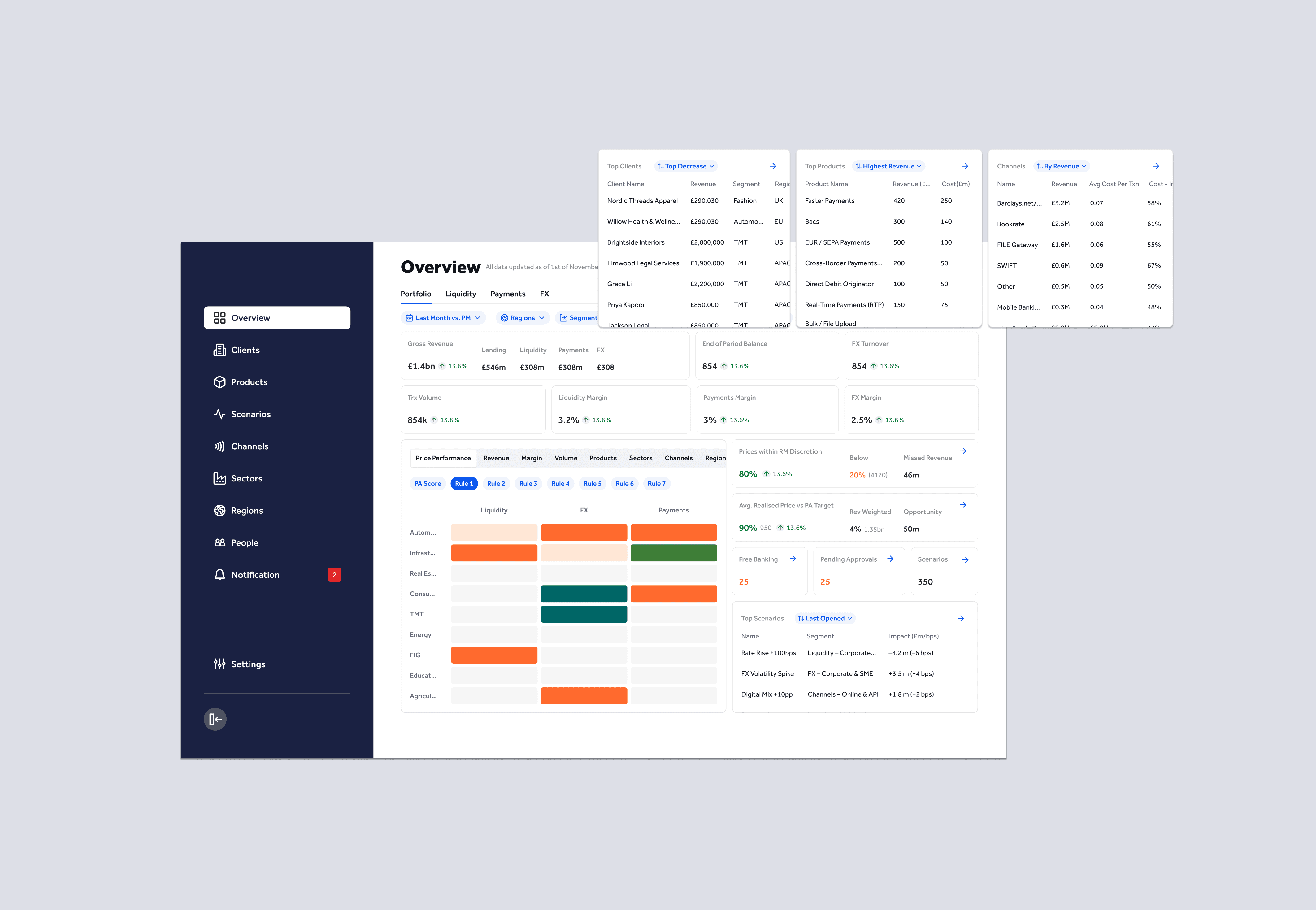
This fintech banking tool helps commercial banking teams understand portfolio performance, detect pricing gaps, and uncover missed revenue opportunities across products, clients, channels, and regions. With an AI-powered pricing assistant, users can surface recommendations, investigate underperforming areas, and create pricing scenarios to evaluate potential business impact before taking action.
My Role
Design Manager
UX Strategy Lead
My Contribution
Product Strategy
Design Leadership
AI Experience Strategy
Workflow Design
Data Visualization Direction
Workflow Design
Pricing Scenario Strategy
Dashboard UX Strategy
Design Mentorship
My Deliverables
Stakeholder Interview Guide
UX Research Plan
AI Recommendation Framework
Journey Maps
Service Blueprint
Prototype
Team
3 Product Designers
1 AI / Machine Learning Engineer
1 Data Scientist
2 Data Engineers
3 Full-Stack Engineers
1 Commercial Banking SME
1 Pricing Strategy SME
1 Liquidity Products SME
1 Risk & Compliance Partner
2 UX Researchers
Commercial banking teams often manage pricing across complex portfolios: liquidity products, payments, FX, channels, sectors, regions, and client segments. Relationship Managers and pricing teams need to understand where revenue is leaking, which clients are priced below target, and how pricing changes may impact revenue, margin, and client relationships.
This project explored a new AI-powered pricing assistant for a fintech banking platform. The product helps commercial banking teams monitor portfolio performance, identify pricing opportunities, and create data-backed pricing scenarios across liquidity, payments, and FX products.
The final experience centered around a unified pricing dashboard with AI-assisted insights, performance diagnostics, scenario creation, and product-level drilldowns.
Commercial banking pricing is high-stakes, fragmented, and difficult to act on quickly.
Pricing teams were working across spreadsheets, static reports, and disconnected product dashboards. This made it hard to answer questions like:
01
Pricing
Where are we underpricing clients?
02
Margins
Which products are driving margin erosion?
03
Discretion
Which clients are receiving excessive pricing discretion?
04
Client Risk
What revenue could we recover without creating unacceptable client risk?
05
Volatility
How would a price change affect liquidity, payments, or FX performance?
Pain Points
Stakeholder interviews and a review of existing tools helped us identify the core pain points the solution needed to address. We spoke with product, pricing, commercial banking, and relationship management stakeholders to understand how pricing decisions were being made today, where workflows were breaking down, and what information teams needed but could not easily access.
These conversations revealed that users were relying on fragmented dashboards, spreadsheets, and manual analysis to monitor portfolio performance, identify underpriced clients, and model pricing scenarios. By pairing these insights with an audit of current solutions, we were able to define the biggest opportunity areas: improving visibility into revenue leakage, reducing manual analysis, making pricing recommendations more actionable, and giving users greater confidence in scenario planning.
Pricing decisions were slowed down by four major issues:
01
Data was fragmented across products
Liquidity, payments, FX, channels, clients, and regions all had different performance views. Users needed a single place to understand portfolio health and drill into individual product areas.
02
Pricing leakage was difficult to detect
Pricing exceptions, below-floor pricing, relationship manager discretion, missed revenue, and free banking leakage were often buried in spreadsheets or separate reports.
03
Scenario planning was manual
Teams wanted to model “what if” pricing changes, but scenario creation required manual calculations and cross-functional support from finance, data, and product teams.
04
Dashboards lacked guidance
Existing analytics could show what happened, but they did not help users decide what to do next. The opportunity was to introduce AI-powered guidance that could surface risks, explain drivers, and recommend scenario actions.
Our design goals were to create a pricing intelligence platform that helps commercial banking teams:
Monitor portfolio performance across liquidity, payments, and FX
Identify revenue leakage and pricing exceptions
Understand which clients, products, and channels are driving performance
Use AI to surface pricing opportunities and risks
Create scenarios to forecast the impact of pricing changes
Screen Mapping
User research gave us a clearer understanding of the information architecture required to support commercial banking pricing workflows. We identified the key categories users needed to navigate, compare, and act on, then mapped how those categories connected across monitoring, diagnosis, and scenario planning. By sharing these flow maps with stakeholders, we were able to test our assumptions early, uncover missing steps, and ensure the product structure aligned with how pricing teams actually make decisions.
Wireframing
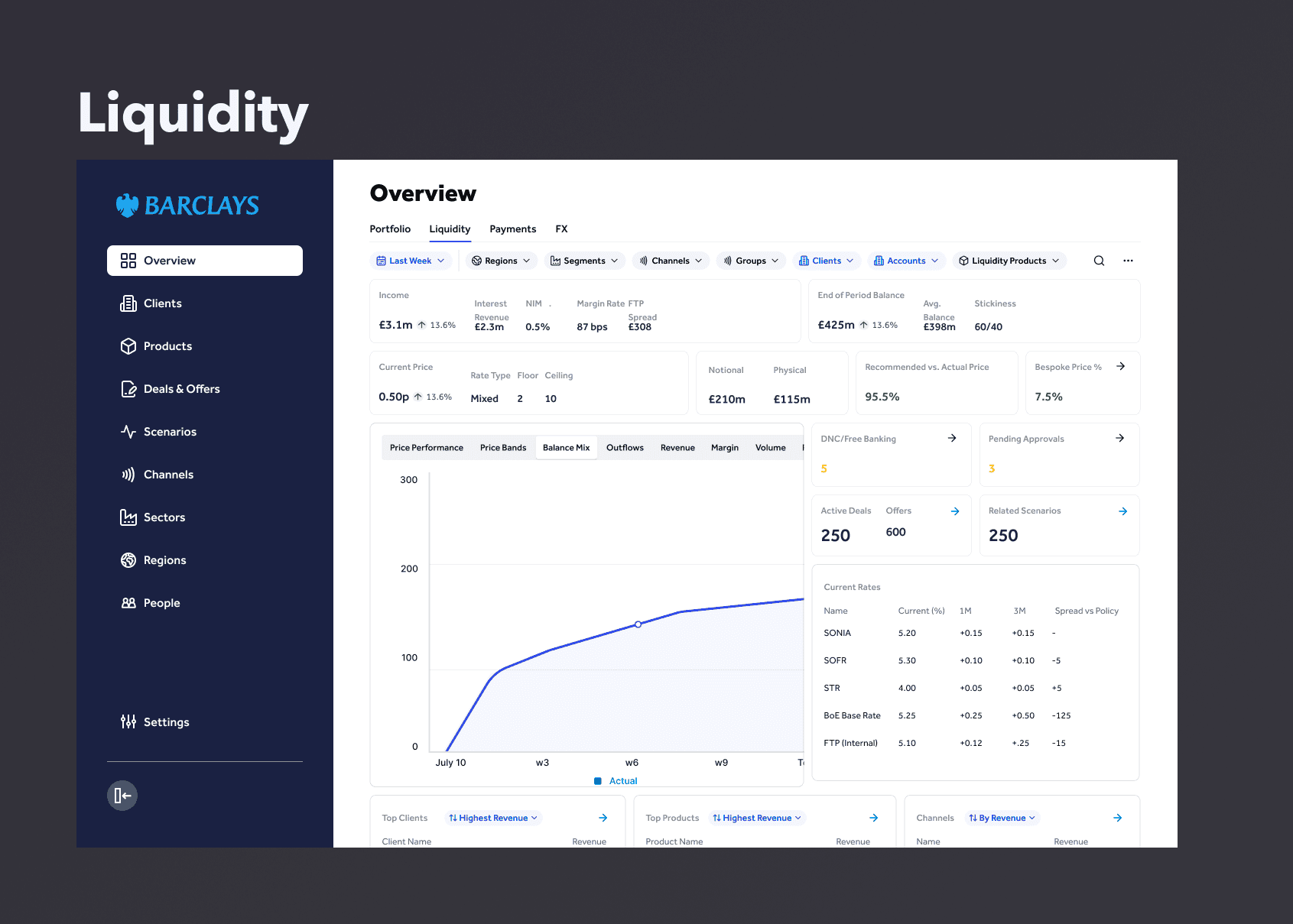
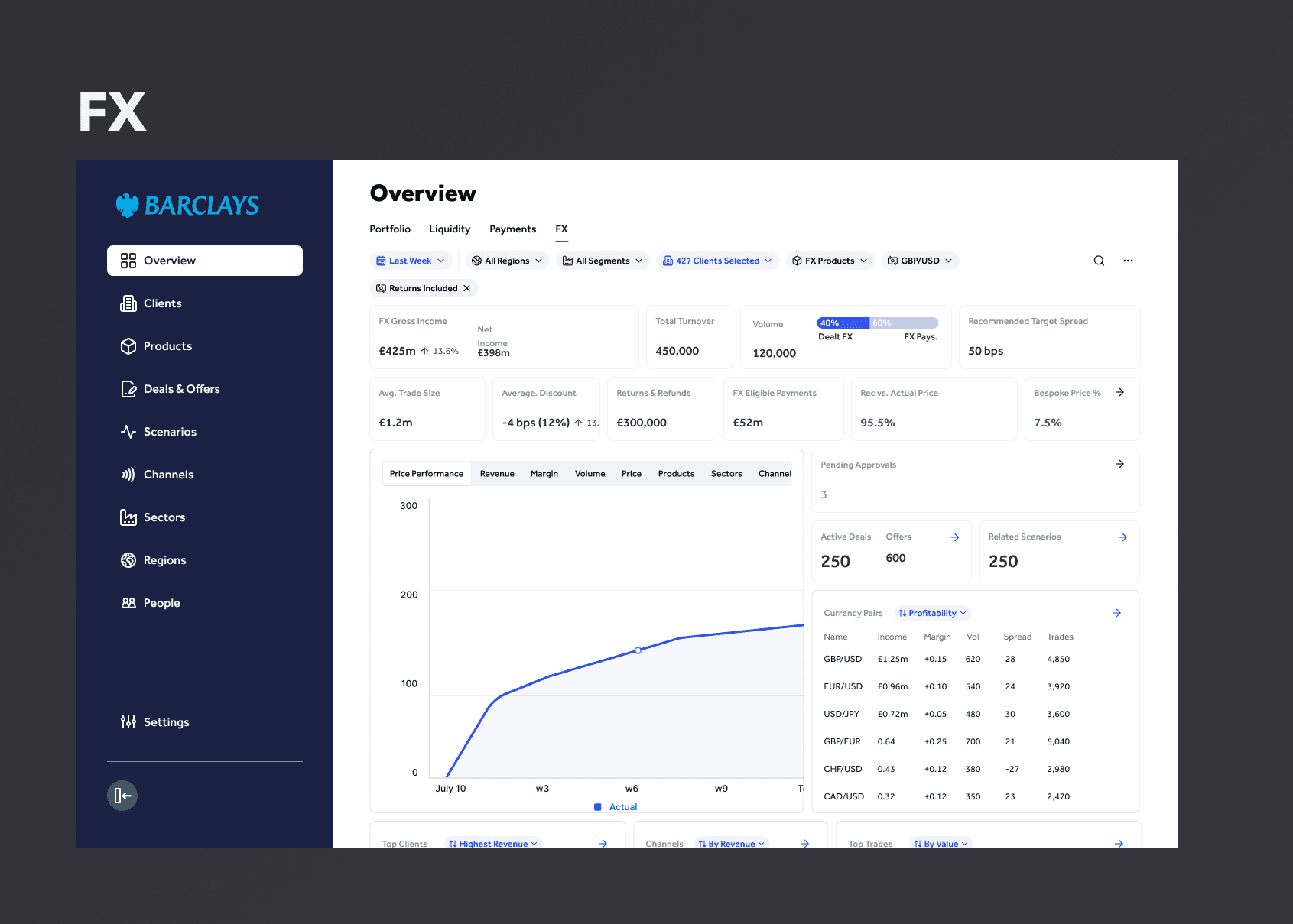
From user research we understood what categories needed to be included in key flows. We mapped these and asked for feedback.

The Solution
The final design transformed a complex commercial banking pricing workflow into a clear, AI-assisted decision platform.
Instead of asking users to interpret fragmented reports, the product helps them understand portfolio performance, identify pricing leakage, and take action through scenario planning.
The final screens balance the needs of commercial banking stakeholders: executive visibility, product-level analysis, client-level drilldown, and AI-powered pricing recommendations.
The result is a scalable fintech dashboard that turns pricing intelligence into guided action.
Impact
6 Month Post-launch Product Impact Metrics
The product accomplished the goal of improving the following things:
Speed of pricing analysis
Visibility into missed revenue
Confidence in pricing decisions
Consistency of pricing governance
Scenario planning efficiency
Cross-product portfolio understandingInstead of asking users to interpret fragmented reports, the product helps them understand portfolio performance, identify pricing leakage, and take action through scenario planning.
Additionally, the client reported the following metrics after 3 months of implementation.
Reduced pricing analysis time by 45%
Increased visibility into missed revenue opportunities across liquidity and payments
Reduced manual spreadsheet work for pricing teams
Improved consistency of pricing decisions across regions and relationship managers
Enabled faster scenario creation for pricing committees
Helped commercial teams prioritize high-value pricing actions